The short answer: Indoor air quality testing can mean a mold air sample, a radon test or a round of meter readings, so the first thing to agree on is the question the test should answer. Settle that, who takes the samples and what the report will contain before anyone comes to the house.
Every rule and figure below comes from the EPA, the Florida Department of Health or Florida law. Each source is listed at the foot of the page with the date we read it.
Questions to Settle Before You Book
Indoor air can go wrong in many ways. The EPA's introduction to indoor air quality names fuel burning appliances, new flooring or carpet, cleaning products, central heating and cooling systems, excess moisture and radon among the sources of indoor air pollution.
A single visit rarely looks at all of them. The questions below apply to any indoor air quality testing Plantation homeowners book, whatever the company.
What Should the Test Answer?
The EPA's mold remediation guide says sampling should be done only after developing a sampling plan that includes a confirmable theory about suspected mold sources and routes of exposure.
Its plain version is worth repeating to the company: figure out what you think is happening and how to prove or disprove it before you sample.
When the EPA Says Sampling May Help
- Cases where litigation is involved.
- When the source of the mold contamination is unclear.
- When health concerns are a problem.
- To check whether an area has been adequately cleaned or remediated, using surface samples.
When Mold Is Already in Sight
The EPA says that in most cases, if visible mold growth is present, sampling is unnecessary. The Florida Department of Health goes further: it does not recommend mold testing or sampling to see if you have a mold problem, or to see what kind of mold might be growing.
Who Will Take the Samples?
In Florida, sampling is part of the job the law calls a mold assessment. Section 468.8411 describes that assessment as physical sampling plus a detailed evaluation of data from a building history and an inspection, done by a mold assessor.
The Department of Business and Professional Regulation licenses and regulates mold assessors. Under section 468.8419, nobody may perform or offer a mold assessment unless the assessor has documented training in water, mold and respiratory protection.
Checking a License
The department's site lets you search its records for professionals it licenses. It says users can verify licenses by name or license number, so ask for the assessor's name before the visit.
What the Statute Says About the Assessor's Insurance
Section 468.8421 says a mold assessor shall maintain general liability and errors and omissions insurance coverage of at least $1 million, for both preliminary and postremediation mold assessment.
Does Anyone Have a Stake in the Result?
Section 468.8419 bars an assessor from inspecting for a fee any property in which the assessor or the assessor's company has a financial or transfer interest.
The same section bars an assessment, or a fee for one, that depends on what the assessment concludes. A flat answer to how the fee is set is a fair thing to ask for.
Is Radon Part of the Test?
Radon is measured apart from mold. The Florida Department of Health's radon page says testing is the only reliable way to find out if your home has elevated levels, and that you can do the test yourself.
If someone else does it for pay, section 404.056 says that person must be certified by the Department of Health to take part in radon measurements, including collecting, analyzing or interpreting samples.
Which Lab and Which Methods?
The EPA's page on mold testing says sample analysis should follow methods recommended by the American Industrial Hygiene Association (AIHA), the American Conference of Governmental Industrial Hygienists (ACGIH) or other professional organizations. Ask which lab will analyze the samples and which methods it follows.
How Many Samples, and One from Outdoors?
The EPA's mold remediation guide lists the pitfalls of sampling by people without experience. Each one makes a good question for the company.
- Too few samples taken.
- Sampling protocols that are not consistent.
- Samples that become contaminated.
- Outdoor control samples left out.
- Costs for samples that were not needed or not suited to the question.
The guide adds that if it is not possible to sample properly, with enough samples to answer the question posed, it would be preferable not to sample.
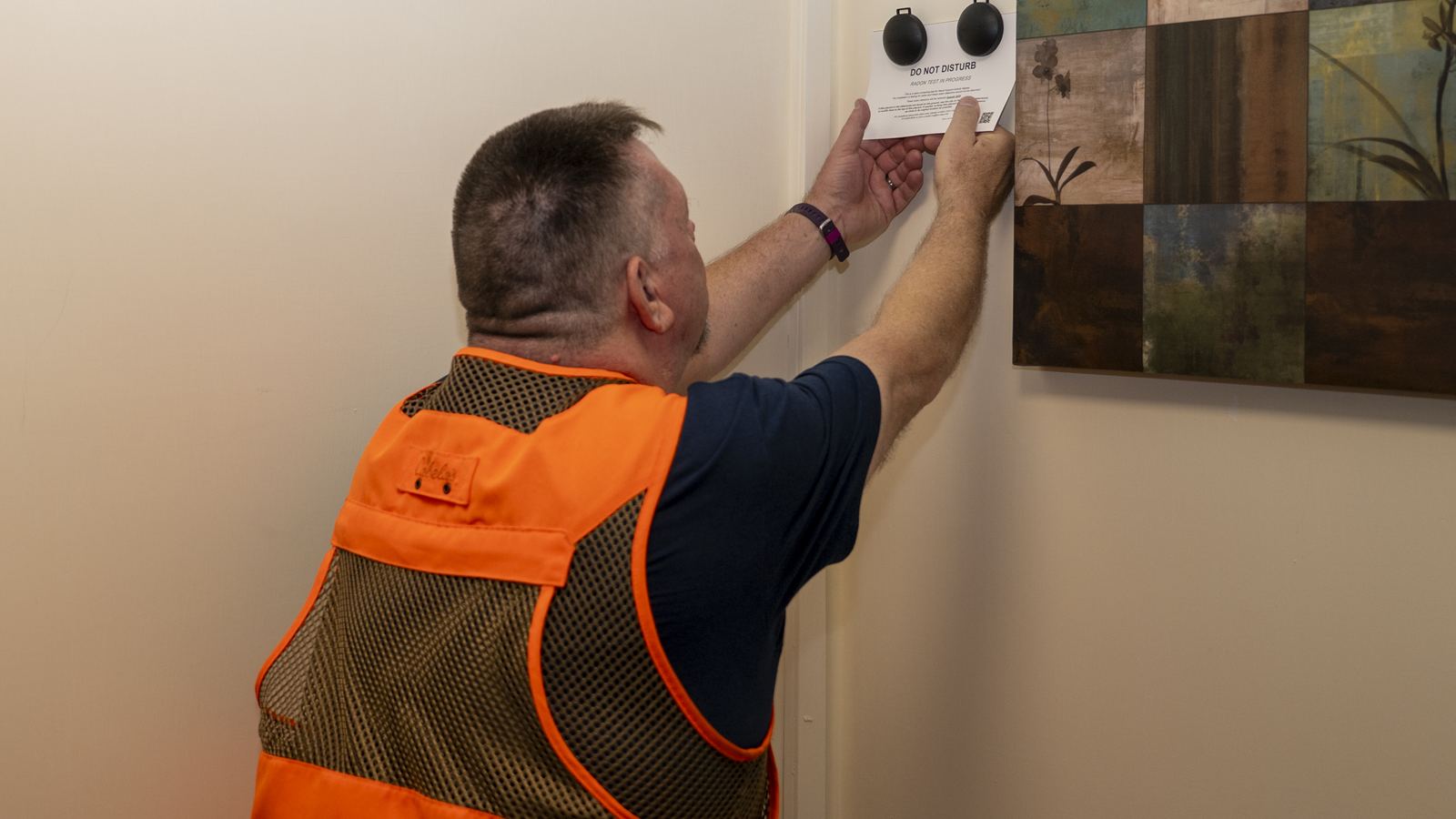
What the Visit Looks Like
Because the law defines an assessment as building history, inspection and sampling together, expect the visit to start with questions rather than with a pump.
The Building History
The assessor is likely to ask about past leaks, floods, roof work, damp spots and smells. Have dates ready if you know them.
The EPA says you may suspect hidden mold if a building smells moldy but you cannot see the source, or if you know there has been water damage and the people inside are reporting health problems.
The Inspection
The EPA's key steps put finding the source or cause of the water or moisture problem near the start. Its guide says to check for high humidity and condensation, actual water leaks, maintenance issues and problems with the heating, ventilation and air conditioning system.
Places the EPA Names for Hidden Mold
- Behind wallpaper and paneling, and the back side of drywall.
- The underside of carpets and pads.
- Walls behind furniture, where condensation forms.
- Condensate drain pans inside air handling units.
- Pipe chases with leaking or condensing pipes.
The Air Samples
The EPA calls air sampling for mold a snapshot. It says air sampling, when properly done, reveals what was in the air at the moment the sample was taken.
The Outdoor Comparison
After remediation, the guide says, indoor air samples should show mold types and concentrations similar to the local outdoor air. That is why an outdoor sample taken at the same visit matters.
What the Report Should Hold
None of the statute sections listed below sets out what a report must contain. The points here are questions to ask, built from the EPA's guidance on sampling.
- The question the testing was meant to answer, and the plan behind it.
- Where each sample was taken, indoors and outdoors.
- The lab that analyzed the samples and the methods it followed.
- Any moisture source or water damage found during the inspection.
- What the results mean, written so you can follow them.
Reading the Numbers
The EPA says no EPA or other federal threshold limits have been set for mold or mold spores, so sampling cannot be used to check a building against federal mold standards.
It also says that for someone without experience, sampling results will be difficult to interpret, and that experience in interpretation is essential. Ask the assessor to walk you through the results line by line.
If the Report Finds Mold
The EPA's message on mold control is that the moisture problem must be fixed, or the mold problem may simply reappear. Our guide to choosing a mold removal company in Plantation covers the next step.
Asking from Plantation
We take requests from homeowners in Plantation and nearby cities, and the same questions apply to mold inspection in Fort Lauderdale.
The short form asks only what you need, your ZIP code, your name and your email address. Details of the house can wait.
Indoor Air Quality Testing in Plantation: Short Answers
Do I need an air test if I can already see mold?
Usually not: as covered above, the EPA treats visible growth as a case where sampling is in most cases unnecessary, with exceptions such as litigation, an unclear source or health concerns. The question to settle with the assessor is what a sample would tell you that the inspection does not.
Will an air test tell me whether my home passes?
Not against any federal standard, since the EPA has set none for mold or mold spores. A single air sample also shows only one moment, as the snapshot point above explains.
Can I test for radon myself?
Yes. The department's radon page says homeowners can run the test themselves; under section 404.056 of the Florida Statutes, it is only people paid for radon measurements who must hold the department's certification.
How much does air testing cost?
We do not quote prices, and the cost depends on how many samples the question needs. The EPA notes that budget is often a consideration when sampling, and that professional advice may be needed to judge whether enough samples can be taken on a given budget. Our mold inspection cost guide explains what changes the price.
Sources
- U.S. Environmental Protection Agency, Introduction to Indoor Air Quality. https://www.epa.gov/indoor-air-quality-iaq/introduction-indoor-air-quality. Read 2026-11-23.
- U.S. Environmental Protection Agency, Mold Remediation in Schools and Commercial Buildings Guide, Chapter 3. https://www.epa.gov/mold/mold-remediation-schools-and-commercial-buildings-guide-chapter-3. Read 2026-11-23.
- U.S. Environmental Protection Agency, Mold Testing or Sampling. https://www.epa.gov/mold/mold-testing-or-sampling. Read 2026-11-23.
- Florida Department of Health, Indoor Mold and Your Health. https://www.floridahealth.gov/community-environmental-public-health/environmental-public-health/air-quality/mold/. Read 2026-11-23.
- Florida Department of Health, Radon. https://www.floridahealth.gov/community-environmental-public-health/environmental-public-health/air-quality/radon/. Read 2026-11-23.
- Florida Department of Business and Professional Regulation, Mold-Related Services. https://www2.myfloridalicense.com/mold-related-services/. Read 2026-11-23.
- Florida Statutes, section 468.8411, Definitions. https://www.leg.state.fl.us/statutes/index.cfm?App_mode=Display_Statute&URL=0400-0499/0468/Sections/0468.8411.html. Read 2026-11-23.
- Florida Statutes, section 468.8419, Prohibitions; penalties. https://www.leg.state.fl.us/statutes/index.cfm?App_mode=Display_Statute&URL=0400-0499/0468/Sections/0468.8419.html. Read 2026-11-23.
- Florida Statutes, section 468.8421, Insurance. https://www.leg.state.fl.us/statutes/index.cfm?App_mode=Display_Statute&URL=0400-0499/0468/Sections/0468.8421.html. Read 2026-11-23.
- Florida Statutes, section 404.056, Environmental radiation standards and projects. https://www.leg.state.fl.us/statutes/index.cfm?App_mode=Display_Statute&URL=0400-0499/0404/Sections/0404.056.html. Read 2026-11-23.
The service
Indoor air quality testing: what each reading covers, from humidity to radon, and who may measure it.
Other guides
Mold testing in Plantation and what a mold inspection report should include.
How to ask
Send a request on the short form. Any work is done by a company whose mold assessor holds a Florida license, which may pay us for the introduction.