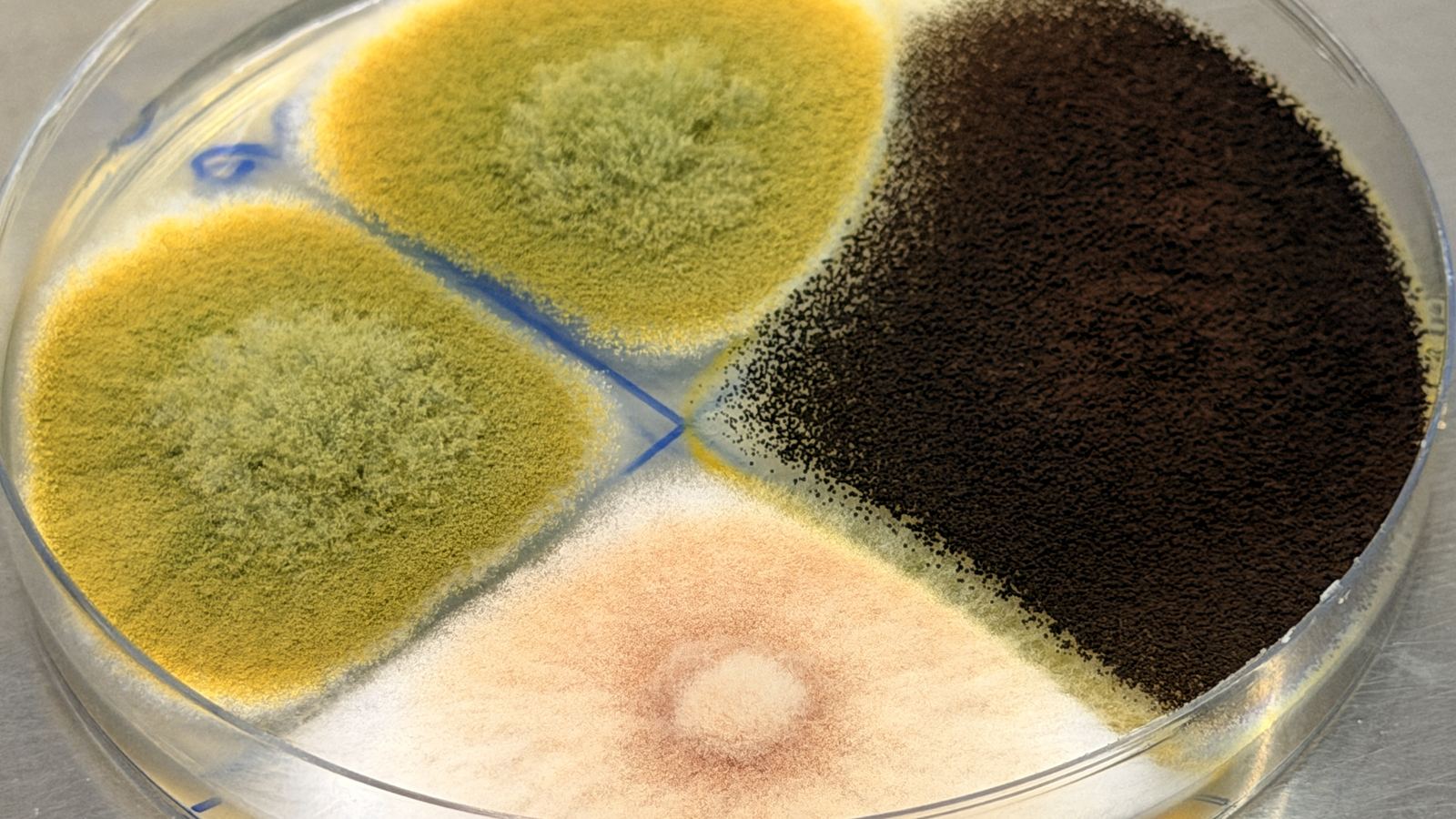
What mold testing is
It is the sampling part of a mold assessment. Someone collects a sample on site, and a lab examines it and reports what it found.
Florida law builds sampling into the definition. A mold assessment "includes the physical sampling and detailed evaluation of data obtained from a building history and inspection" (Florida Statutes 468.8411).
The looking, the moisture readings and the written findings are covered on our page about mold inspection and testing. This page is about the samples alone.
| State health department's view | Does not recommend testing to see if you have a mold problem (Florida Department of Health) |
|---|---|
| Kinds of samples | Air, surface, bulk and water (EPA) |
| Federal limits for mold spores | None have been set (EPA) |
| How labs should analyze | Methods recommended by AIHA, ACGIH or other professional organizations (EPA) |
| After a cleanup | Indoor mold should be similar to the local outdoor air (EPA) |
| Who may assess for mold | A mold assessor licensed by Florida DBPR |
How a testing visit usually runs

1. Set the question
The assessor asks what you have seen, smelled and repaired. They decide whether a sample would answer anything a look cannot.

2. Take the samples
If sampling makes sense, they collect air, surface, bulk or water samples. EPA counts leaving out outdoor control samples as a pitfall.

3. Send to a lab
The samples go to a lab for analysis. EPA says labs should follow methods recommended by AIHA, ACGIH or similar groups.

4. Explain the results
The assessor reads the lab report against the building and the outdoor sample. Ask for that explanation in writing, in plain words.
When the health agencies say to skip it
The Florida Department of Health answers the question directly on its mold page.
"Indoor mold growth can usually be seen or smelled. In most cases, if visible mold growth is present, sampling is not needed."
The Department also says it "does not recommend mold testing or sampling to see if you have a mold problem, or to see what kind of mold might be growing." Source: Florida Department of Health, Mold, read 2026-11-23.
The same page warns that air sampling "can be expensive and, if done, should only be done by experienced professionals."
Why the type of mold rarely changes the plan
The Department says that if you think you have a mold problem, "you do not need to find out what type of mold you may have," because all molds should be treated the same for health risks and removal.
The CDC says the same in fewer words: "CDC does not recommend mold testing," and "No matter what type of mold is present, you need to remove it" (CDC, Mold).
When mold spore testing can help
EPA leaves room for sampling in some cases. Its guide for schools and commercial buildings says you may consider it in specific instances, such as when litigation is involved, when the source of the mold is unclear, or when health concerns are a problem (EPA, chapter 3).
The same guide says sampling may help to:
- locate the source of mold contamination
- identify some of the mold species present
- tell mold apart from soot or dirt
- show, before and after a cleanup, whether the remediation worked
A sample should answer a question
EPA says sampling should follow a plan with "a confirmable theory regarding suspected mold sources and routes of exposure." In its words: "Figure out what you think is happening and how to prove or disprove it before you sample."
So a fair thing to ask any assessor is what each sample is meant to prove, and what result would change the next step.
The kinds of mold samples
EPA names four types of samples. Each one looks at a different place in the building.
Air samples
An air sample, often searched for as mold spore testing, captures what is floating in a room at that moment. The Florida Department of Health notes that mold "is virtually everywhere, floating in the air and on all surfaces."
A snapshot, not a record
EPA compares air sampling to a snapshot: when properly done, it shows "what was in the air at the moment when the sample was taken." Our page on mold air sampling covers this type in more depth.
Surface samples
A surface sample comes from the face of a material rather than the air. EPA says surface sampling may be useful to find out whether an area has been adequately cleaned or remediated; see mold surface sampling.
Bulk samples
A bulk sample is a piece of the material itself. EPA's examples are chunks of carpet, insulation and wallboard.
Water samples
EPA lists water samples from condensate drain pans or cooling towers. The Florida Department of Health separately advises checking around air conditioners for standing water and routinely inspecting their drain pans and drain lines.
How a lab reports mold results
The assessor collects the samples, and a lab does the analysis. EPA says that analysis "should follow analytical methods recommended by the American Industrial Hygiene Association (AIHA), the American Conference of Governmental Industrial Hygienists (ACGIH), or other professional organizations" (EPA, Mold Testing or Sampling).
Indoor results next to outdoor results
Because there is no fixed limit, an indoor air result means little on its own. EPA lists leaving out outdoor control samples as a pitfall of inexperienced sampling.
EPA also gives the measure used after a cleanup: the types and concentrations of mold in indoor air "should be similar to what is found in the local outdoor air."
No number to pass or fail
EPA says standards or Threshold Limit Values for airborne mold "have not been set," and there are "no EPA regulations or standards for airborne mold contaminants."
The Florida Department of Health adds that "There are no health or exposure-based standards that you can use to evaluate a mold sampling result." The CDC says there are no set standards for an acceptable quantity of mold in a home.
Mold names on the report
A report may name some of the mold types found, since EPA says sampling can identify some of the species present. The health department's advice above still applies: the name does not change how mold is treated.
Reading the report
EPA is plain about this: "For someone without experience, sampling results will be difficult to interpret. Experience in interpretation of results is essential."
Ask the assessor to put in writing what the results say about your building, where the moisture is, and what happens next.
Where testing goes wrong
EPA lists the pitfalls it sees when inexperienced people take samples:
- too few samples
- sampling methods that are not consistent
- samples that become contaminated
- no outdoor control samples
- costs for samples that were not needed or were the wrong kind
EPA goes further: if it is not possible to take enough samples to answer the question, "it would be preferable not to sample." It warns that inadequate sample plans "may generate misleading, confusing and useless results."
Who may take mold samples
Florida licenses mold assessors and mold remediators through the Department of Business and Professional Regulation (DBPR), which also regulates them (DBPR, Mold-Related Services). Under state law, a mold assessor is any person who performs or directly supervises a mold assessment.
Two rules that protect the result
Florida Statutes 468.8419 bars a person from accepting an engagement to conduct an assessment in which "the assessment itself, or the fee payable for the assessment, is contingent upon the conclusions of the assessment."
The same section bars inspecting for a fee any property in which the assessor or the assessor's company has a financial or transfer interest.
Other ways to find mold
Sampling is one tool among several, and often not the first. A mold visual inspection looks for growth and water damage, and thermal imaging has its own page.
After a leak or a flood, start with mold inspection after water damage. For stuffy air or odors without visible growth, see indoor air quality testing, and for offices or rental buildings see commercial mold inspection.
Our home page explains how a request through this site works.
Questions About Mold Samples, Answered
Is mold testing worth it if I can see mold?
Usually not, according to the Florida Department of Health. It says that in most cases, if visible mold growth is present, sampling is not needed. The CDC also does not recommend it, and says mold should be removed whatever its type.
What does a normal mold test result look like?
There is no official normal. EPA says no federal limits have been set for mold or mold spores, and the Florida Department of Health says there are no health or exposure-based standards to judge a result against. After a cleanup, EPA says indoor air should hold mold types and amounts similar to the local outdoor air.
Does mold spore testing tell me what kind of mold I have?
It can name some of it. EPA says sampling may identify some of the mold species present. The Florida Department of Health says you do not need to know the type, because all molds should be treated the same for health risks and removal.
Should the area be tested after mold removal?
EPA says surface sampling may be useful to find out whether an area has been adequately cleaned or remediated, and that sampling before and after a cleanup can show whether it worked. If samples are taken, the kinds and amounts of mold indoors should be similar to those outside. Our page on mold surface sampling covers that step.
Will the Florida Department of Health test my home?
No. Its mold page says the Department "does not provide mold testing or support to professional consultants." It does give technical advice to the public and can direct people to local resources.
Who can I ask to take mold samples?
In Florida, a mold assessment is done by a mold assessor licensed through DBPR, and the DBPR license search lets you check a license by name or number. Through this site you can send a request; any work is done by a company whose mold assessor holds a Florida license, which may pay us for the introduction.
Sources
- Florida Department of Health, Mold. https://www.floridahealth.gov/community-environmental-public-health/environmental-public-health/air-quality/mold/. Read 2026-11-23.
- U.S. EPA, Mold Testing or Sampling. https://www.epa.gov/mold/mold-testing-or-sampling. Read 2026-11-23.
- U.S. EPA, Mold Remediation in Schools and Commercial Buildings Guide, chapter 3. https://www.epa.gov/mold/mold-remediation-schools-and-commercial-buildings-guide-chapter-3. Read 2026-11-23.
- U.S. EPA, A Brief Guide to Mold, Moisture and Your Home. https://www.epa.gov/mold/brief-guide-mold-moisture-and-your-home. Read 2026-11-23.
- CDC, Mold. https://www.cdc.gov/mold-health/about/index.html. Read 2026-11-23.
- Florida DBPR, Mold-Related Services. https://www2.myfloridalicense.com/mold-related-services/. Read 2026-11-23.
- Florida DBPR, license search (Verify a Licensee). https://www.myfloridalicense.com/portalsearches/VerifyLicensee. Read 2026-11-23.
- Florida Statutes 468.8411, Definitions. https://www.leg.state.fl.us/statutes/index.cfm?App_mode=Display_Statute&URL=0400-0499/0468/Sections/0468.8411.html. Read 2026-11-23.
- Florida Statutes 468.8419, Prohibitions; penalties. https://www.leg.state.fl.us/statutes/index.cfm?App_mode=Display_Statute&URL=0400-0499/0468/Sections/0468.8419.html. Read 2026-11-23.
Where we take requests
Plantation, Fort Lauderdale, Davie, Miami and the rest of Broward County. See all areas.
Related services
Mold inspection and testing, visual inspection, thermal imaging, air sampling, surface sampling, indoor air quality testing, commercial mold inspection and inspection after water damage. See all services.
Read first
Mold inspection cost: what changes the price. Florida mold license rules: how to check a license.
Ask About Mold Testing for Your Home
Fill in the short form. Any work is done by a company whose mold assessor holds a Florida license, which may pay us for the introduction.