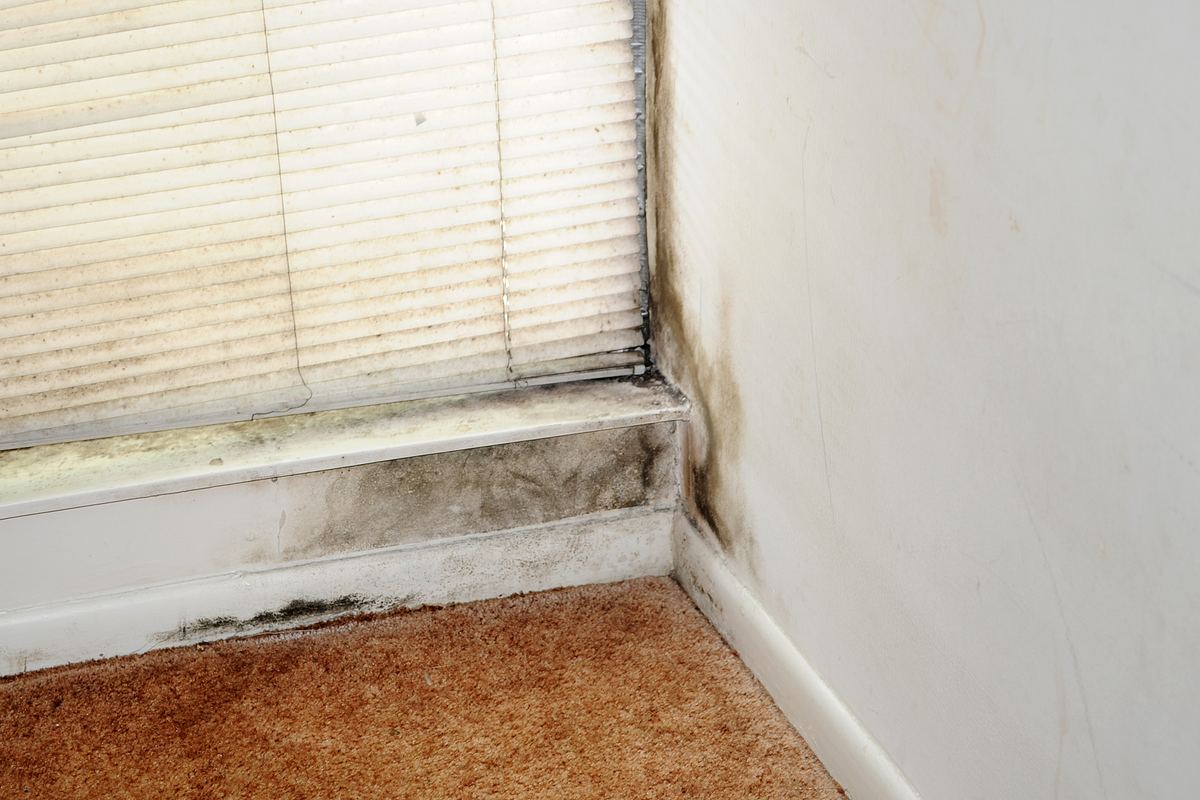
Mold Inspection in Fort Lauderdale: What It Is and Who Does It
A mold inspection is a licensed person working out where mold is growing in a home and where its water comes from. Florida law calls this a mold assessment and builds it on a building history and an inspection (Florida Statutes 468.8411).
The building history matters more in Fort Lauderdale than in a newer suburb. About 65 percent of the city's housing units were built before 1980, by the Census Bureau's latest five year estimate, so many homes here have decades of roof, plumbing and storm history to go through.
Cobalt Heron Mold Referrals does not do the visit. We are a referral service run by Pensacola SEO Company, and in Fort Lauderdale any visit is made by a company whose mold assessor holds a Florida license, if one takes your request.
The Florida Department of Business and Professional Regulation is responsible for licensing and regulating mold assessors and mold remediators (DBPR, Mold-Related Services). Before you hire anyone, check the license of the assessor (or remediator) the company sends, and that goes for a company you reach through us too.
What Happens After You Send a Request

1. You ask
Send the short form about your Fort Lauderdale home. You do not pay us to ask.

2. Who does the work
When a company accepts the request, the work is its own, done through its Florida licensed mold assessor. It may pay us for the introduction.

3. If a visit follows
A Florida licensed mold assessor at that company, not us, may look at the home. Expect questions about leaks, floods and past repairs.

4. Report and next step
Ask for written findings: where the mold is and where its water comes from. Cleanup, if needed, is a separate quote from a Florida licensed mold remediator.
Mold Testing in Fort Lauderdale
Testing means taking air or surface samples for a lab. Before you pay for mold testing in Fort Lauderdale, read what the state's health agency says about it.
The Florida Department of Health puts it this way: "In most cases, if visible mold growth is present, sampling is not needed" (Florida Department of Health, Mold).
If a company quotes mold testing for your Fort Lauderdale home, ask what the result will tell you that a look at the wall will not.
Mold Remediation and Mold Removal in Fort Lauderdale
Mold removal is taking the growth and the moldy material out. Mold remediation is the whole job, and in Florida law that word covers treating more than 10 square feet of mold or moldy material.
The EPA's warning is blunt: "If you clean up the mold, but don't fix the water problem, then, most likely, the mold problem will come back" (EPA, A Brief Guide to Mold, Moisture and Your Home).
For mold remediation in Fort Lauderdale, fixing the water can mean looking past the plumbing. The city itself says high water tables after rain can raise the probability of localized flooding.
We do none of this work. If a company takes a mold removal request in Fort Lauderdale, the work is done by one whose mold remediator holds a Florida license, and its price and its work are its own.
Black Mold Removal in Fort Lauderdale
A request for black mold removal in Fort Lauderdale is handled like any other mold request. The Florida Department of Health says: "you do not need to find out what type of mold you may have."
Florida's definition of mold remediation starts at mold growth of greater than 10 square feet (Florida Statutes 468.8411), and it does not mention the color or the type of mold.
What Makes Mold Likely in Fort Lauderdale Homes
The Florida Department of Health puts mold in four words: water is the key. Fort Lauderdale gives water several ways into a house, and each fact below comes from a public record you can open.
Water on every side
165 miles of waterways
The City of Fort Lauderdale counts more than 165 miles of waterways winding through its neighborhoods (City of Fort Lauderdale, Waterways). The city calls itself the Venice of America for that reason, and it names canals, rivers and the Intracoastal Waterway among those waterways.
Low, flat ground and flood zones
The city describes itself as located in a low, flat geographical area. Its flood page says it is surrounded by water, which makes it especially susceptible to flooding (City of Fort Lauderdale, Floods and Flood Insurance).
The same page says a majority of the city's residents live in or close to a Special Flood Hazard Area, as mapped by FEMA. You can look up one address on the FEMA Flood Map Service Center.
King tides every fall
Fort Lauderdale typically has its highest tides in September, October and November, the city says (City of Fort Lauderdale, High Tides and King Tides). It names Victoria Park as prone to tidal flooding, Southeast Isles as having significant tidal impacts, and Middle River Terrace as a place where rain and king tides flood together.
Salt water in the street is not mold. It is a reason to think back to whether water has ever reached your garage, your ground floor or the base of your walls.
Rain that comes in one long season
NOAA's 1991 to 2020 climate normals for its Fort Lauderdale station show a wet city with a wet half of the year (NOAA, U.S. Climate Normals, station FT LAUDERDALE). This is a different station from the one at the airport, so its figures differ from airport figures you may see elsewhere.
| Normal rain in a year | 68.77 inches |
|---|---|
| May through October | 49.13 inches, about 71 percent of the year |
The April 12, 2023 flood
The National Weather Service office in Miami called the April 12, 2023 Fort Lauderdale flash flood by far the most significant flood event of that year in South Florida. It wrote that the flood displaced residents of entire neighborhoods for as much as a week (NWS Miami, South Florida 2023 Weather Summary).
If your home took water that day and a wall was closed up without being opened and dried, that is the kind of building history a mold assessment is built on.
The homes themselves
The Census Bureau's 2020 to 2024 American Community Survey describes the city's housing (U.S. Census Bureau, table DP04 for Fort Lauderdale city). Two things stand out in that table.
Most were built between 1950 and 1979
| Built 1950 to 1959 | 19.6 percent |
|---|---|
| Built 1960 to 1969 | 19.9 percent |
| Built 1970 to 1979 | 21.4 percent |
Age alone does not grow mold. It does mean more years in which one of the moisture sources the Department of Health lists could have happened, such as a roof leak, a plumbing leak or an overflowing air conditioner drain pan.
As many condo towers as houses
In the same table, 37.6 percent of Fort Lauderdale's housing units are in buildings with 20 or more units, and 34.0 percent are detached single family houses. Renters live in 45.9 percent of the occupied homes.
In a large building the water may start in a unit, a roof or a pipe that is not yours. An association or a landlord may decide who can get into the places an assessor needs to see.
Indoor air in a wet climate
The Department of Health advises keeping indoor humidity below 60 percent. It adds that if you have central air conditioning and still need a dehumidifier to get below that level, you should have the air conditioning system examined for problems.
The EPA notes that relative humidity indoors can be measured with a small, inexpensive humidity meter.
What a company may ask about a Fort Lauderdale home
The form asks only what you need, your ZIP code, your name and your email address. The company doing the work may ask about the rest:
- Whether the home is a house, a townhouse or a unit in a larger building.
- Roughly when it was built, if you know.
- Whether it sits on a canal or has ever had tide or storm water inside.
- What you see or smell, and in which room.
For a home outside the city, see Broward County, Davie or Plantation.
Mold Inspection Questions From Fort Lauderdale
How much does a mold inspection cost in Fort Lauderdale?
No government or university source publishes a Florida price for a mold inspection, so none is printed for Fort Lauderdale. Ask a company that receives your request for its price in writing, and ask what the visit covers and whether lab samples are included.
Is there a free mold inspection in Fort Lauderdale?
You do not pay us to ask. Whether the visit is charged for is the company's decision, so ask before you book. If a visit is offered at no charge, ask what is being sold afterward: for 12 months after assessing a home, a Florida mold assessor may not perform or offer the remediation there, with an exception for certain certified contractors (Florida Statutes 468.8419).
Who do I call for mold in a Fort Lauderdale home?
For finding the mold and its water source, a Florida licensed mold assessor. For the cleanup, a Florida licensed mold remediator; Florida's definition of mold remediation starts at more than 10 square feet. The state licensing agency regulates both, and you can start with either through our contact page.
My home is in a flood zone. Does that mean it has mold?
No. A flood zone describes flood risk, and the city says a majority of Fort Lauderdale residents live in or close to a Special Flood Hazard Area. What matters is whether materials got wet and how long they stayed wet: the EPA's guide puts the drying window at 24 to 48 hours after a leak or spill.
Do I need mold testing if I can already see the mold?
Usually not, for the reason given under mold testing above. The EPA says surface samples may be useful after a cleanup, to check that an area was cleaned well enough.
Sources
- Florida Statutes section 468.8411, Definitions (mold assessment, mold remediation). https://www.leg.state.fl.us/statutes/index.cfm?App_mode=Display_Statute&URL=0400-0499/0468/Sections/0468.8411.html. Read 2026-11-22.
- Florida Statutes section 468.8419, Prohibitions; penalties. https://www.leg.state.fl.us/statutes/index.cfm?App_mode=Display_Statute&URL=0400-0499/0468/Sections/0468.8419.html. Read 2026-11-22.
- Florida Department of Business and Professional Regulation, Mold-Related Services. https://www2.myfloridalicense.com/mold-related-services/. Read 2026-11-22.
- Florida Department of Health, Mold (Indoor Mold and Your Health). https://www.floridahealth.gov/community-environmental-public-health/environmental-public-health/air-quality/mold/. Read 2026-11-22.
- U.S. Environmental Protection Agency, A Brief Guide to Mold, Moisture and Your Home. https://www.epa.gov/mold/brief-guide-mold-moisture-and-your-home. Read 2026-11-22.
- City of Fort Lauderdale, Waterways. https://www.fortlauderdale.gov/Residents/Waterways. Read 2026-11-22.
- City of Fort Lauderdale, Floods and Flood Insurance. https://www.fortlauderdale.gov/Residents/Floods-and-Flood-Insurance. Read 2026-11-22.
- City of Fort Lauderdale, High Tides and King Tides. https://www.fortlauderdale.gov/Residents/High-Tides-and-King-Tides. Read 2026-11-22.
- FEMA Flood Map Service Center. https://msc.fema.gov/portal/home. Read 2026-11-22.
- NOAA National Centers for Environmental Information, U.S. Climate Normals Quick Access, 1991 to 2020 normals, station FT LAUDERDALE (USC00083163). https://www.ncei.noaa.gov/access/us-climate-normals/#dataset=normals-annualseasonal&timeframe=30&location=FL&station=USC00083163. Read 2026-11-22.
- NOAA National Centers for Environmental Information, 1991 to 2020 annual climate normals, station FT LAUDERDALE, FL US (USC00083163) (data file). https://www.ncei.noaa.gov/access/services/data/v1?dataset=normals-annualseasonal-1991-2020&stations=USC00083163&format=json&includeStationName=true&includeStationLocation=true&dataTypes=ANN-PRCP-NORMAL,ANN-TAVG-NORMAL,ANN-PRCP-AVGNDS-GE001HI,ANN-PRCP-AVGNDS-GE100HI. Read 2026-11-22.
- NOAA National Centers for Environmental Information, 1991 to 2020 monthly precipitation normals, station FT LAUDERDALE, FL US (USC00083163) (data file). https://www.ncei.noaa.gov/access/services/data/v1?dataset=normals-monthly-1991-2020&stations=USC00083163&format=json&dataTypes=MLY-PRCP-NORMAL. Read 2026-11-22.
- National Weather Service Miami-South Florida, South Florida 2023 Weather Summary. https://www.weather.gov/media/mfl/news/2023Summary.pdf. Read 2026-11-22.
- U.S. Census Bureau, American Community Survey 2020 to 2024 five year estimates, table DP04 (Selected Housing Characteristics), Fort Lauderdale city, Florida. https://data.census.gov/table/ACSDP5Y2024.DP04?g=160XX00US1224000. Read 2026-11-22.
Nearby areas
Broward County, Davie and Plantation. We take requests from Miami too.
How this works
We are a referral service, not a mold company. If a company takes your request, any visit or work is done by one whose mold assessor or remediator holds a Florida license, as the steps above show.
Ready to ask
Send a request about your Fort Lauderdale home. The form is short.
Ask About Mold in Your Fort Lauderdale Home
Send a short form. Any work on a Fort Lauderdale request is done by a company whose mold assessor or remediator holds a Florida license, if one takes it, and that company may pay us for the introduction.