What indoor air quality testing covers
Indoor air quality testing is a set of separate readings, not one number. The U.S. Environmental Protection Agency (EPA) defines indoor air quality as the air quality within and around buildings, especially as it relates to the health and comfort of the people inside.
The EPA names indoor sources that release gases or particles into the air as the primary cause of indoor air problems. It adds that too little ventilation, and high temperature and humidity, can raise the levels of some pollutants.
So a full picture has several parts. The sections below take them one at a time: humidity, particles, carbon dioxide, chemical gases, then radon and carbon monoxide, and finally who is allowed to measure what.
Sources the EPA lists inside a home
- Fuel-burning appliances, such as gas stoves and heaters.
- Building materials and furnishings, such as newly installed flooring, upholstery or carpet, and cabinetry or furniture made of certain pressed wood products.
- Products for cleaning, personal care and hobbies.
- Central heating and cooling systems and humidification devices.
- Excess moisture.
- Outdoor sources that come in, such as radon, pesticides and outdoor air pollution.
The four stages of an air quality visit

1. They ask what you notice
The company asks about smells, damp spots, recent painting or new furniture, and any leaks. Those answers point to which readings are worth taking.

2. They read the humidity
The assessor may measure relative humidity room by room. The EPA gives below 60 percent as the target and 30 to 50 percent as ideal.

3. They measure or sample
Depending on the question, they may take readings or air or surface samples for a lab. Ask what each one is meant to answer before it is taken.

4. They report the results
Ask for the readings and findings in writing, with where each was taken. A written report lets you compare results and show them to anyone you hire next.
Humidity: the reading behind mold
Humidity is where air quality and mold meet. The Florida Department of Health says mold needs moisture to grow, and that molds can grow almost anywhere there is enough moisture or high humidity.
The ranges the agencies give
The EPA says to keep indoor humidity below 60 percent relative humidity if possible, and ideally between 30 and 50 percent.
The Florida Department of Health says most experts suggest a relative humidity of less than 60 percent, and that below 50 percent is best for controlling both mold growth and dust mites.
How humidity is measured
The EPA says relative humidity can be measured with a moisture or humidity meter, a small instrument sold at many hardware stores. It also says condensation can be a sign of high humidity.
When the air conditioner is not keeping up
The Florida Department of Health says that if you have central air conditioning and still need a dehumidifier to bring relative humidity below 60 percent, you should have the air conditioning system examined for problems.
Particles in indoor air
Particle pollution is a mix of tiny solid and liquid bits suspended in the air. The EPA's page on indoor particulate matter says it is especially concerned about particles 10 micrometers across or smaller, because these particles are inhalable.
Where indoor particles come from
The EPA says indoor particles include particles from outdoors that migrate in and particles made indoors. Its list of indoor sources covers cooking, burning candles, fireplaces, unvented space heaters or kerosene heaters, cigarette smoking and some hobbies.
Indoor particles can also be of biological origin, the EPA says. The Florida Department of Health says molds produce microscopic spores that are spread easily through the air.
What changes indoor particle levels
The EPA says indoor particle levels depend on outdoor levels, air leaking in, the ventilation and filtration systems used, indoor sources and what the people inside are doing. In homes without smoking or other strong particle sources, it expects indoor levels to be the same as, or lower than, outdoor levels.
Carbon dioxide and ventilation
Carbon dioxide is mostly a ventilation reading. The National Institute of Standards and Technology (NIST) says the gas is part of the air we breathe out, that good ventilation keeps it and many other contaminants low, and that poor ventilation lets them accumulate.
NIST says the direct effect of indoor carbon dioxide on health is unclear, but its level can serve as an indicator of a building's ventilation rate. It also says carbon dioxide can easily be tracked with widely available monitors.
Reading a carbon dioxide number
NIST says a level of 1,000 parts per million (ppm) or higher is commonly seen as a sign of poor indoor air quality, and that this rule of thumb could be misleading. The right level depends on the number of people, their activity, the outdoor level and the size of the building.
The EPA puts it briefly: carbon dioxide levels indoors can give information about ventilation but need to be interpreted carefully.
VOCs and other chemical gases
Volatile organic compounds, or VOCs, are gases given off by certain solids and liquids. The EPA's page on VOCs says concentrations of many VOCs are consistently higher indoors than outdoors, up to ten times higher.
Common sources of VOCs
- Paints, paint strippers and other solvents.
- Aerosol sprays, cleansers and disinfectants.
- Moth repellents and air fresheners.
- Stored fuels and automotive products.
- Building materials and furnishings.
- Glues, adhesives and permanent markers.
Why timing matters for a VOC reading
The EPA says that during and for several hours after certain activities, such as paint stripping, VOC levels may be 1,000 times background outdoor levels. A reading taken right after painting or cleaning tells a different story from one taken on an ordinary day.
Formaldehyde
The EPA calls formaldehyde one of the best known VOCs and one of the few indoor air pollutants that can be readily measured.
Radon and carbon monoxide
Two gases sit apart from the rest because nobody can sense them. Each has its own testing route.
Radon
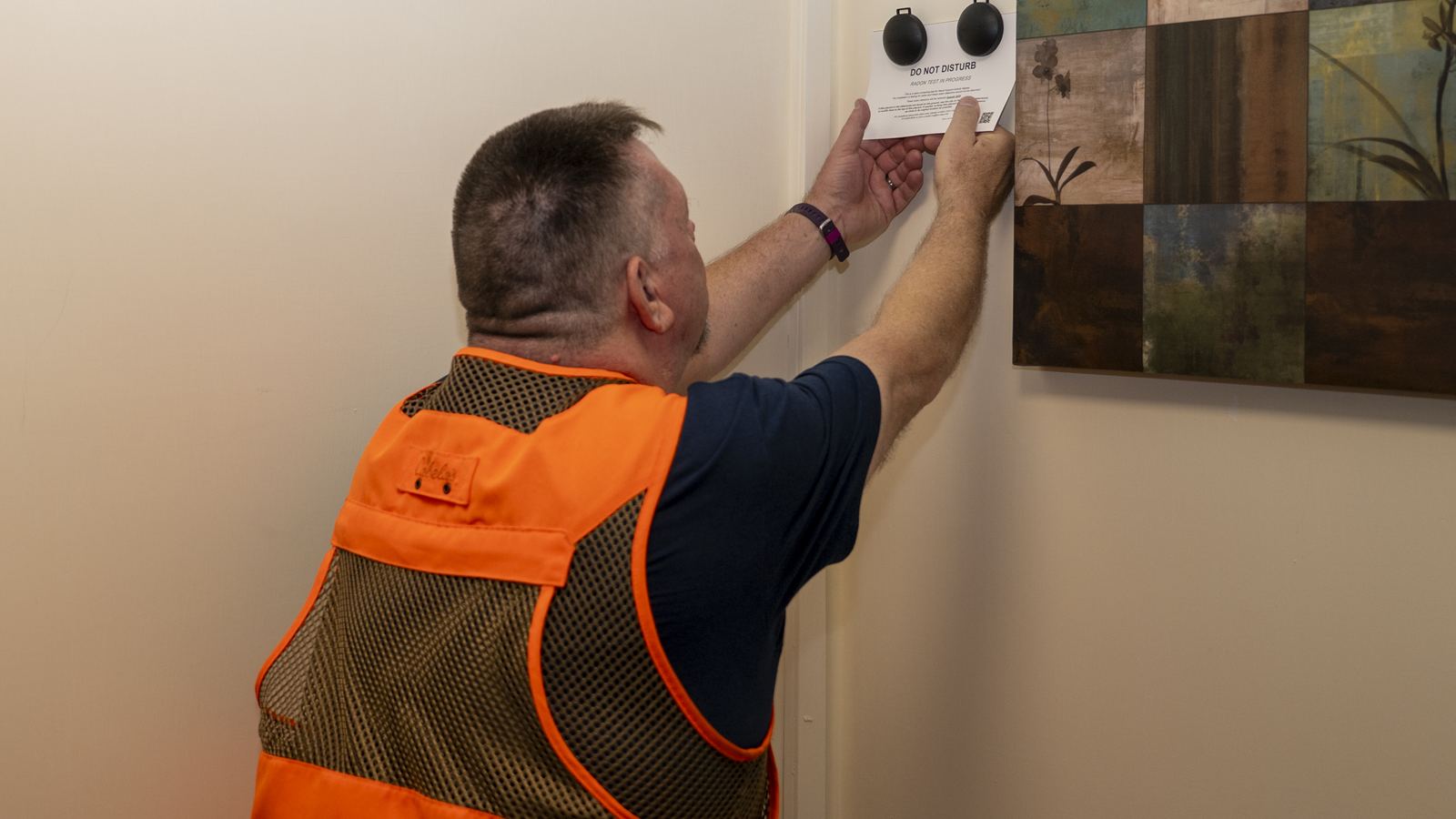
The Florida Department of Health's radon page describes radon as a colorless, odorless, tasteless gas that comes from the decay of radium in the soil. It says testing is the only reliable way to find out if there are elevated levels in your home, and that you can do the test yourself.
The department says its data indicates that 1 in 5 Florida residences has radon levels above the EPA action level. The EPA's radon chart says to fix your home at 4 picocuries per liter (pCi/L) and to consider fixing between 2 and 4 pCi/L.
Florida law puts a radon notice on home sales and rentals. Section 404.056 of the Florida Statutes requires it on at least one document signed at or before a sale contract or rental agreement, in these words: "Additional information regarding radon and radon testing may be obtained from your county health department."
Carbon monoxide
The EPA calls carbon monoxide an odorless, colorless and toxic gas. It gives average levels in homes without gas stoves of 0.5 to 5 ppm, levels near properly adjusted gas stoves of often 5 to 15 ppm, and 30 ppm or higher near poorly adjusted stoves.
The EPA reports that the U.S. Consumer Product Safety Commission recommends carbon monoxide alarms on each level of every home, outside each sleeping area. The commission also urges a yearly professional inspection of all fuel-burning appliances.
Who measures what in air quality testing
Different parts of air quality testing fall under different rules in Florida. Knowing which is which helps you ask the right company for the right reading.
| Mold | A mold assessor, licensed by the Florida Department of Business and Professional Regulation. |
|---|---|
| Radon | You can test yourself, says the Florida Department of Health. Anyone paid for radon measurement must be certified by the department, under section 404.056. |
| Humidity | A humidity meter from a hardware store, says the EPA. |
| Carbon dioxide | Widely available monitors, says NIST, with readings that need care to interpret. |
| Carbon monoxide | Alarms on each level outside sleeping areas, as the EPA reports the Consumer Product Safety Commission recommends. |
| Formaldehyde | One of the few indoor air pollutants that can be readily measured, says the EPA. |
Mold: a Florida licensed mold assessor
The Department of Business and Professional Regulation is responsible for licensing and regulating mold assessors and mold remediators. Florida Statutes 468.8411 defines a mold assessor as any person who performs or directly supervises a mold assessment.
State law describes that assessment as physical sampling and a detailed look at the building history and an inspection, to form a first view of the origin, identity, location and extent of mold growth of more than 10 square feet.
Radon: a person certified by the health department
Section 404.056 says a person may not take part in radon measurements, including sample collection, analysis or interpretation, and charge a fee for it unless that person is certified by the Florida Department of Health. It allows an uncertified business to subcontract radon measurements to a certified radon business and pass on the complete report.
The other readings
The two rules above name mold and radon. For humidity, particles, carbon dioxide and VOCs, ask the company doing the work which of these it measures, with what equipment, and how it will explain the numbers.
Where mold fits in air quality testing
If a company takes a request from this site, the work is done by one whose mold assessor holds a Florida license. So a request covers only the mold side of air quality testing: send a request to ask, and our home page sets out how a request works.
Mold is often found by sight and smell first. The Florida Department of Health says indoor mold growth can usually be seen or smelled, that an earthy or musty odor may mean a mold problem, and that it does not recommend mold testing or sampling to see if you have a mold problem.
The EPA adds that no EPA or other federal limits have been set for mold or mold spores. Where sampling is done, it says it should be done by professionals with specific experience in designing sampling protocols and interpreting results.
The mold services in this group
- Mold inspection and testing: the full check for mold and the water behind it.
- Mold visual inspection: looking for growth, stains and damp before any sample.
- Thermal imaging mold inspection: finding cold, damp spots behind surfaces.
- Mold testing: when a sample answers a real question.
- Mold air sampling: the mold part of the air picture.
- Mold surface sampling: tape or swab samples from a surface.
- Mold inspection after water damage: after a flood, storm or leak.
- Commercial mold inspection: for offices, shops and other buildings.
Our guide to mold and indoor air quality explains how mold and moisture affect the air in more detail.
Indoor Air Quality Testing: Common Questions
What does indoor air quality testing measure?
It depends on who does it and what you ask for. The parts covered by official guidance are humidity, particles, carbon dioxide as a sign of ventilation, VOCs such as formaldehyde, radon, carbon monoxide and mold. Ask the company which of these it includes before the visit.
Can I test my home's air quality myself?
For some readings, yes. The EPA says relative humidity can be measured with a humidity meter from a hardware store, and the Florida Department of Health says you can test for radon yourself. NIST says carbon dioxide can be tracked with widely available monitors, and the EPA reports that the Consumer Product Safety Commission recommends carbon monoxide alarms on each level of a home. Mold is different: a mold assessment is work for a Florida licensed mold assessor.
What indoor humidity level is best?
The EPA says to keep indoor humidity below 60 percent if possible, and ideally between 30 and 50 percent. The Florida Department of Health says below 50 percent is best for controlling both mold growth and dust mites. Condensation on windows or pipes can be a sign that humidity is high, the EPA says.
Is mold air sampling part of air quality testing?
It can be one part, and only when it answers a question. The EPA says that in most cases, if visible mold growth is present, sampling is unnecessary, and that no federal limits have been set for mold spores. See mold air sampling and mold testing for how those samples are used.
Who can do air quality testing near me?
The work behind a request here is done by a company whose mold assessor holds a Florida license, so the mold side is what we take requests for. Radon measurement for a fee needs a Florida Department of Health certification under section 404.056. For the other readings, ask the company doing the work what it measures and how.
Sources
- U.S. Environmental Protection Agency, Introduction to Indoor Air Quality. https://www.epa.gov/indoor-air-quality-iaq/introduction-indoor-air-quality. Read 2026-11-23.
- U.S. Environmental Protection Agency, A Brief Guide to Mold, Moisture and Your Home. https://www.epa.gov/mold/brief-guide-mold-moisture-and-your-home. Read 2026-11-23.
- U.S. Environmental Protection Agency, Indoor Particulate Matter. https://www.epa.gov/indoor-air-quality-iaq/indoor-particulate-matter. Read 2026-11-23.
- U.S. Environmental Protection Agency, Volatile Organic Compounds' Impact on Indoor Air Quality. https://www.epa.gov/indoor-air-quality-iaq/volatile-organic-compounds-impact-indoor-air-quality. Read 2026-11-23.
- U.S. Environmental Protection Agency, Carbon Monoxide's Impact on Indoor Air Quality. https://www.epa.gov/indoor-air-quality-iaq/carbon-monoxides-impact-indoor-air-quality. Read 2026-11-23.
- U.S. Environmental Protection Agency, Health Risk of Radon. https://www.epa.gov/radon/health-risk-radon. Read 2026-11-23.
- U.S. Environmental Protection Agency (archived January 2025 snapshot), Can I measure carbon dioxide (CO2) indoors to get information on ventilation?. https://19january2025snapshot.epa.gov/indoor-air-quality-iaq/can-i-measure-carbon-dioxide-co2-indoors-get-information-ventilation. Read 2026-11-23.
- National Institute of Standards and Technology, NIST's Indoor CO2 Tool Can Help Assess Ventilation and Indoor Air Quality. https://www.nist.gov/news-events/news/2022/07/nists-indoor-co2-tool-can-help-assess-ventilation-and-indoor-air-quality. Read 2026-11-23.
- Florida Department of Health, Indoor Mold and Your Health. https://www.floridahealth.gov/community-environmental-public-health/environmental-public-health/air-quality/mold/. Read 2026-11-23.
- Florida Department of Health, Radon. https://www.floridahealth.gov/community-environmental-public-health/environmental-public-health/radon/. Read 2026-11-23.
- Florida Department of Business and Professional Regulation, Mold-Related Services. https://www2.myfloridalicense.com/mold-related-services/. Read 2026-11-23.
- Florida Statutes section 468.8411, mold-related services: definitions. https://www.leg.state.fl.us/statutes/index.cfm?App_mode=Display_Statute&URL=0400-0499/0468/Sections/0468.8411.html. Read 2026-11-23.
- Florida Statutes section 404.056, environmental radiation standards; certification of persons performing radon measurement or mitigation; notification on real estate documents. https://www.leg.state.fl.us/statutes/index.cfm?App_mode=Display_Statute&URL=0400-0499/0404/Sections/0404.056.html. Read 2026-11-23.
Where we take requests
We take requests from Plantation, Davie, Fort Lauderdale, Miami and other parts of Broward County. See all areas.
Related services
Mold inspection and testing, visual inspection, thermal imaging, mold testing, air sampling, surface sampling, inspection after water damage and commercial inspection. See all services.
Read first
Ask about the mold side of your air
Send the short form. Any work is done by a company whose mold assessor holds a Florida license, which may pay us for the introduction.