The short answer: What causes house mold in Plantation is the same thing that causes it anywhere, water, and the city's wet summers and humid air give it more chances. If growth is already showing, the mold inspection page explains what a visit from a Florida licensed mold assessor can cover.
We are a referral service, not a mold company. The weather and housing numbers below come from federal data, and the statements about mold come from the agency named beside each one.
Water Comes First
The Florida Department of Health says mold needs moisture to grow, and that molds can grow almost anywhere there is enough moisture or high humidity. So the useful question for a Plantation house is where its water comes from.
The department's list of indoor moisture sources has two groups that matter most here: water that gets in from outside, and water the house makes or carries itself.
How Much Rain Falls on Plantation
NOAA keeps 30 year climate normals for a station it names FT LAUDERDALE, FL US, which sits east of Plantation's center. For 1991 to 2020 its normal yearly precipitation is 68.77 inches.
The same normals count an average of 149.2 days a year with at least a hundredth of an inch of rain.
The Wet Months and the Dry Months
The rain is not spread evenly. NOAA's monthly normals for the station show the summer and early fall carrying most of it:
| June | 9.38 inches |
|---|---|
| July | 7.64 inches |
| August | 8.25 inches |
| September | 9.97 inches |
| October | 7.26 inches |
| December | 2.69 inches |
| January | 2.89 inches |
June, July and August alone have a normal of 25.27 inches. A small roof or window leak that stays quiet in January can be fed day after day in those months.
How Rain Becomes Indoor Water
The Florida Department of Health names water leaks from outside the building, through the roof, walls and floors, as one source of indoor moisture. It also lists flooding from outside, such as storm water and overflowing lakes.
Roof Leaks Above the Ceiling
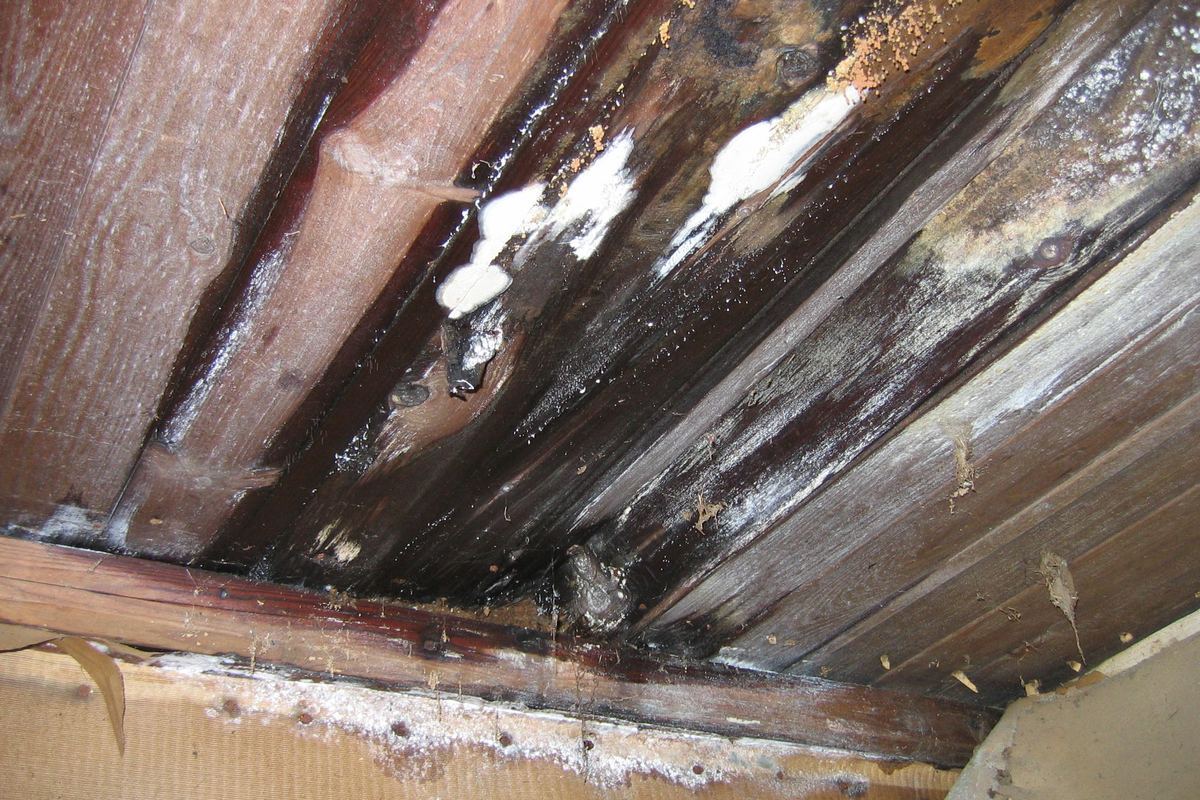
A roof leak often shows up late. The EPA's Brief Guide names roof materials above ceiling tiles as a place mold may hide, due to roof leaks or insufficient insulation.
How Humid the Air Stays
The National Weather Service says the dew point is a better judge of how humid the air is than relative humidity. In its words, the higher the dew point rises, the greater the amount of moisture in the air.
NOAA does not publish hourly humidity normals for the Fort Lauderdale stations. The nearest station in its hourly normals is Miami International Airport, and its 1991 to 2020 figures show how damp South Florida air is:
| August, every hour of the day | dew point 73.4 to 75.6 °F |
|---|---|
| July, every hour of the day | dew point 72.9 to 75.1 °F |
| January, every hour of the day | dew point 56.9 to 60.6 °F |
For scale, the Weather Service office that wrote that explainer calls a summer dew point of 65 or more lots of moisture in the air, becoming oppressive. The Miami normals sit above that line all day and all night through the summer.
Why Humid Air Turns Into Water on Cool Surfaces
The Weather Service defines the dew point as the temperature air must be cooled to for its relative humidity to reach 100 percent. Cooled any further, it says, water vapor has to come out of the air as liquid.
That is the condensation the Florida Department of Health lists as a moisture source, caused by indoor humidity that is too high or surfaces that are too cold. The department also names warm, moist air from outdoors as a source of its own.
Where That Condensation Hides
The EPA's Brief Guide lists hidden spots that fit an air conditioned house in a humid place. It names walls around leaking or condensing pipes, the surface of walls behind furniture where condensation forms, and the inside of ductwork.
The Age of Plantation's Homes
By the Census Bureau's American Community Survey 2020 to 2024 estimates, most of the City of Plantation's roughly 40,014 housing units went up before 1990, and Plantation homes by age gives every decade. These are the rows that matter here:
| Built 1960 to 1969 | 11.5 percent |
|---|---|
| Built 1970 to 1979 | 24.2 percent |
| Built 1980 to 1989 | 26.7 percent |
| Built 1990 to 1999 | 18.6 percent |
| Built 2020 or later | 2.8 percent |
The agency guides on this page do not list a house's age among the causes of mold. What they list are the parts that carry or hold water, and in a house that has stood through decades of wet seasons those are the parts worth knowing: the air conditioner and the plumbing, along with the roof, covered above.
The Air Conditioner as a Water Source
An air conditioner pulls water out of the air, and that water has to go somewhere. The Florida Department of Health lists overflow from air conditioner drain pans among the ways a house floods from the inside.
The department points to the same equipment when it describes where to look. Its list: standing water around air handling units, and the evaporator coils, liner surfaces, drain pans and drain lines, which it says to inspect routinely.
When Mold Is in the System Itself
The EPA says not to run the heating, ventilation and air conditioning system if you know or suspect it is contaminated with mold, because it could spread mold throughout the building. It points readers to its guide Should You Have the Air Ducts in Your Home Cleaned? first.
The Florida Department of Health admits the tension in a Florida summer: stopping the system would make most Florida buildings very uncomfortable. Its answer is that the system should ideally be shut down while cleaning or mold removal is done.
Plumbing Leaks Behind Walls and Cabinets
Indoor plumbing leaks and broken water pipes are on the Florida Department of Health's list, along with overflow from sinks, tubs and toilets. These leaks do not need a storm, so they cause mold in the dry months too.
Signs That Point to a Hidden Leak
The department tells homeowners to look for signs of moisture or water damage: water leaks, standing water, water stains and condensation. The EPA adds that hidden mold may be suspected when a building smells moldy but you cannot see the source.
A slow leak is often found by its damage before its drip. When the cause is a burst pipe or an overflow that has already soaked the floor, the mold inspection after water damage page covers that case.
Putting the Causes Together
For a house in Plantation, the pattern is heavy rain from June through October, humid air in every summer hour, and a roof, an air conditioner and pipes that each have to keep that water in its place. Mold follows wherever one of them lets water stay.
The same climate covers the neighboring city, so a home there faces the same list; see what a mold inspection in Fort Lauderdale covers. For a season by season routine to keep water out, read how to prevent mold in a Florida home.
What Causes House Mold in Plantation: Short Answers
Does all this rain mean every Plantation house will grow mold?
No. The Florida Department of Health says mold needs moisture to grow, so rain becomes a cause only when it gets inside and stays. A roof, walls and windows that keep the water out leave the spores in the air with nothing to start on.
Why does this page use a Miami weather station for humidity?
NOAA's hourly normals, which include dew point, are not published for the Fort Lauderdale stations. Miami International Airport is the nearest station in that set, so its figures stand in for South Florida air. The rainfall figures come from the station NOAA names FT LAUDERDALE, FL US, east of Plantation's center.
Can a newer house in Plantation still get mold?
Yes. Many of the moisture sources the Florida Department of Health lists have nothing to do with age, such as poor venting of kitchen and bathroom moisture, drying clothes indoors and humidifier use. An air conditioner drain pan can overflow in a new house as easily as in an old one.
Who works out where the water is coming from?
Under Florida Statutes section 468.8411, a mold assessment includes evaluating a building history and inspection to form an initial hypothesis about the origin, identity, location and extent of mold growth of greater than 10 square feet. The state licensing department says only individuals are licensed for this work, so the license belongs to the mold assessor, not a company. To ask for one, send a request; a company whose assessor holds a Florida license may pay us for the introduction.
Sources
- NOAA National Centers for Environmental Information, U.S. Climate Normals 1991 to 2020, annual and seasonal, station USC00083163 FT LAUDERDALE, FL US. https://www.ncei.noaa.gov/access/services/data/v1?dataset=normals-annualseasonal-1991-2020&stations=USC00083163&format=json&includeStationName=true&includeStationLocation=true&dataTypes=ANN-PRCP-NORMAL,ANN-PRCP-AVGNDS-GE001HI,JJA-PRCP-NORMAL. Read 2026-11-23.
- NOAA National Centers for Environmental Information, U.S. Climate Normals 1991 to 2020, monthly precipitation, station USC00083163. https://www.ncei.noaa.gov/access/services/data/v1?dataset=normals-monthly-1991-2020&stations=USC00083163&dataTypes=MLY-PRCP-NORMAL&format=csv&includeStationName=true&units=standard. Read 2026-11-23.
- NOAA National Centers for Environmental Information, U.S. Climate Normals 1991 to 2020, hourly, station USW00012839 MIAMI INTL AP, FL US. https://www.ncei.noaa.gov/data/normals-hourly/1991-2020/access/USW00012839.csv. Read 2026-11-23.
- National Weather Service La Crosse, Dew Point vs Humidity. https://www.weather.gov/arx/why_dewpoint_vs_humidity. Read 2026-11-23.
- U.S. Census Bureau, American Community Survey 5 year estimates 2020 to 2024, DP04 Selected Housing Characteristics, Plantation city, Florida. https://data.census.gov/table/ACSDP5Y2024.DP04?g=160XX00US1257425. Read 2026-11-23.
- U.S. Census Bureau, 2025 Gazetteer Files, Florida places (city center point). https://www2.census.gov/geo/docs/maps-data/data/gazetteer/2025_Gazetteer/2025_gaz_place_12.txt. Read 2026-11-23.
- Florida Department of Health, Mold. https://www.floridahealth.gov/community-environmental-public-health/environmental-public-health/air-quality/mold/. Read 2026-11-23.
- U.S. Environmental Protection Agency, A Brief Guide to Mold, Moisture and Your Home (last updated February 18, 2026). https://www.epa.gov/mold/brief-guide-mold-moisture-and-your-home. Read 2026-11-23.
- The 2026 Florida Statutes, section 468.8411, Definitions (mold-related services). https://www.leg.state.fl.us/statutes/index.cfm?App_mode=Display_Statute&URL=0400-0499/0468/Sections/0468.8411.html. Read 2026-11-23.
- Florida Department of Business and Professional Regulation, Mold-Related Services FAQs. https://www2.myfloridalicense.com/mold-related-services/faqs/. Read 2026-11-23.
The service
Mold inspection: what a Florida licensed mold assessor's visit can look at when the cause is not obvious.
Other guides
How to prevent mold in a Florida home and mold after water damage.
How to ask
Send a request through the short form; you do not pay us to ask. A company whose mold assessor holds a Florida license may pay us for the introduction.